django-mjml-templates
Write email as .mjml templates, render and send them from a normal Django view. No Node, no
new template engine: it's Django's template backend with .mjml files compiled to email HTML,
and a plain-text part made for you.
Setup
# settings.py
TEMPLATES = [{
    "BACKEND": "mjml_templates.django.DjangoTemplates",  # was django.template.backends.django.DjangoTemplates
    ...
}]
Only templates ending in .mjml are treated as email; everything else renders as before.
The template
{# templates/email/invite.mjml #}
<mjml>
  <mj-head><mj-title>{{ inviter.get_full_name }} invited you to {{ team.name }}</mj-title></mj-head>
  <mj-body>
    <mj-section><mj-column>
      <mj-text>Hi {{ invite.name }}, join {{ team.name }} on Example.</mj-text>
      <mj-button href="{% url 'accept_invite' invite.token %}">Accept</mj-button>
    </mj-column></mj-section>
  </mj-body>
</mjml>
A Django template first ({% extends %}, {% url %}, autoescaping), then MJML. <mj-title> is
the subject.
The view
from django.shortcuts import get_object_or_404, redirect
from django.template.loader import get_template


def send_invite(request, team_id):
    team = get_object_or_404(Team, pk=team_id, owner=request.user)
    invite = Invite.objects.create(team=team, email=request.POST["email"])

    message = get_template("email/invite.mjml").render_email(
        {"invite": invite, "team": team, "inviter": request.user},
        request,                      # absolute URLs come from the request
        to=[invite.email],
    )
    message.send()
    return redirect("team", team.pk)
render_email gives back a Django EmailMultiAlternatives: subject from <mj-title>, HTML
from the MJML, plain text generated from it. Attach files, set reply_to, or send it in a
Celery task like any other Django message.
Looking at it before it goes
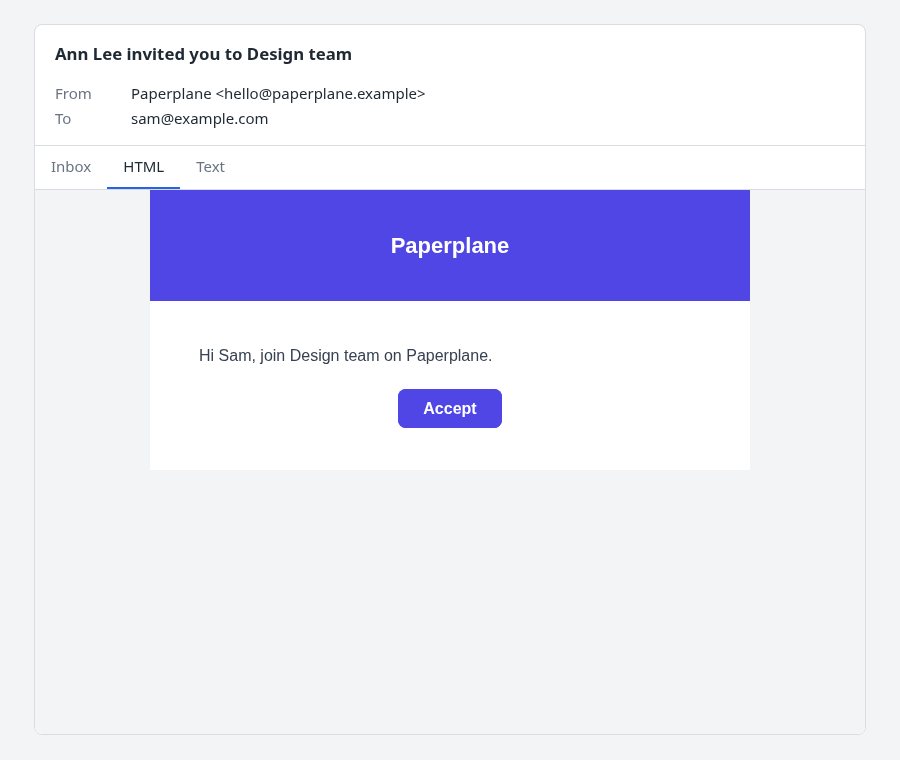
Another view returns the same message as a page: an inbox row, the HTML and the text.
from django.contrib.admin.views.decorators import staff_member_required
from mjml_templates.preview import preview_response


@staff_member_required
def invite_preview(request):
    message = get_template("email/invite.mjml").render_email(
        {"invite": sample_invite(), "team": sample_team(), "inviter": request.user}, request
    )
    return preview_response(message)
Where next
How-to
- Build a simple design: a base template with the look, and emails that fill it
- Write a shared layout:
{% extends %}, the subject, a hand-written.txt - Send from a task or command: Celery, attachments, one email per recipient
- Test an email:
mail.outboxandrender_email_parts - Make links absolute: tasks, commands and
MJML_BASE_URL - Preview an email: a page, or a fragment in your own
- Customise the preview: colours, dark mode, markup
Reference
- API:
render_email,render_email_parts, the subject, URL rules, settings - The plain-text fallback: how each construct comes out as text
- Preview: arguments, tabs, properties, blocks, safety
Explanation
- Why this
- How a render works: the steps, and what their order means
- How the preview is designed: why it is a function, and the safety choices